

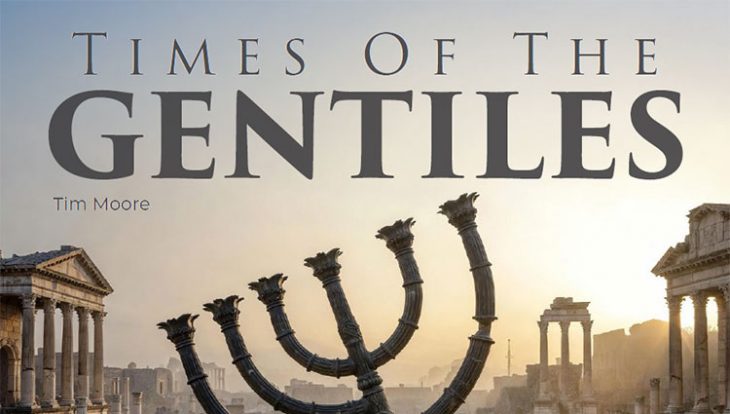
It is often difficult to recognize where you are or what is happening “in the moment.” We can reflect on the past, gaining additional insight through hindsight. And we can ponder and anticipate what lies ahead. But in that continually transiting instant we call the present, perspective can slip away.
Even in the flow of Church history, significant developments and key transition points are best recognized in hindsight. Whether Luther’s 95 Theses, various sweeping revivals, or a slide into apostasy, Christians living through those moments did not initially realize the import of the times they were experiencing. Consider the testimony of Scripture regarding the sons of Issachar. Although all of Israel was living through the same moment in time, they were lauded for their ability “to discern the times, to know what Israel should do” (1 Chronicles 12:32).
Reflecting on the past 100 years, most of the Gentile Church has been asleep. Although the signs of the times have been multiplying before our eyes—increasing in frequency and intensity, and converging like never before—most faithful followers of Christ seem oblivious that the hour is growing prophetically late.
Jewish or Gentile
Is the Church Jewish or Gentile? In fact, it is both. But over its nearly 2,000 years history, the Church has morphed from a solely Jewish body to a predominantly Gentile body. Following the introduction of the Gospel throughout the Roman Empire, the Church grew exponentially among the Gentile nations of the world. Sadly, the number and percentage of Jewish believers dwindled over the years.
Clearly, there have always been some Jews who believed in Yeshua Hamashiach. But over time, as many Gentile Church leaders expressed disdain for the Church’s Jewish heritage, Jewish resistance to what Jews came to see as a Gentile religion grew more entrenched. In that cauldron of increasing division and mistrust, Satan sowed seeds of persecution and antisemitism—driving the wedge even further.
Ignored by Jews and Gentiles alike were the words of Jesus to the Canaanite (Gentile) woman: “I was sent only to the lost sheep of the house of Israel” (Matthew 15:24). The fact that He then responded to her faith (and that of other Gentiles) affirmed that He also offers grace to all who come to Him. Paul later clarified that the Gospel is for “the Jew first and also to the Greek (Gentile)” (Romans 1:16 and 2:10). He also urged us not to be uninformed of a mystery: “that a partial hardening has happened to Israel until the fullness of the Gentiles has come in” (Romans 11:25). I have personally witnessed an accelerating thawing in Jewish receptivity to the Gospel, which tells me that we are nearing the “fullness of the Gentiles” Paul wrote about.
During the Church Age, Paul emphasized that Gentile followers of Christ should be intentional about “making the Jews jealous” of the faith they now have in the God of Abraham, Isaac, and Jacob (Romans 11:11). The entirety of Romans 9–11 points to God’s continuing plan of salvation for the Jewish people—and their primacy as a chosen nation according to the irrevocable covenant He sealed by His own oath.
Simply put, many Gentile Christians misinterpret the discipline of God as an invalidation of His promises. In doing so, they neglect the clear teaching of Bible prophecy and undermine their own claim to take God at His Word.
Moses’ Warning… and Promise
In Deuteronomy 28 and 29, Moses warned what would happen if the Children of Israel wandered away from God. Delivered shortly after Israel’s 40 years of wandering in the wilderness due to their disobedience at Mount Sinai, his words resonated deeply with the people. They thought, surely our children and our grandchildren will learn from the hard lessons we’ve experienced. Surely they will remain faithful to the Lord our God. But they did not.
The curses Moses foretold were much more lengthy and descriptive than even the blessings promised for faithfulness:
- Dispersal
- Persecution
- Desolation
All the curses Moses foretold (much more lengthy and descriptive than even the blessings promised for faithfulness) came to pass following the Jews’ widespread rejection of the Messiah 2,000 years ago. They were scattered “from one end of the Earth to the other end of Earth” beginning in AD 70 (Deuteronomy 28:64). In those varied foreign lands, they found no rest in their persecution, but were given “a trembling heart, failing eyes, and despair of soul” (Deuteronomy 28:65). By the middle of the 20th Century, millions of Jews were living out the prophecy of Deuteronomy 28:67: “In the morning you shall say, ‘Would that it were evening!’ And at evening you will say, ‘Would that it were morning!’ because of the dread of your heart which you dread, and for the sight of your eyes which you will see.”
Even the Land became desolate as Moses prophesied. Bereft of its God-ordained inhabitants, it became “a burning waste, unsown and unproductive” (Deuteronomy 29:23).
But Moses also prophesied blessings that would flow in the fullness of time—not because Israel had earned God’s providence, but because He is faithful and will keep all His promises to Abraham, Isaac, and Jacob, as well as David and others. The blessing would follow the curse as described in passages such as Deuteronomy 30, Ezekiel 36 and 37, and Isaiah 43 and 54.
“‘For a brief moment I forsook you, but with great compassion I will gather you. In a flood of fury I hid My face from you for a moment, but with everlasting lovingkindness I will have compassion on you,” says the LORD your Redeemer'” (Isaiah 54:7-8, NIV).
Why did the Lord promise to regather, restore, rejuvenate, and redeem the house of Israel (a prophetically accurate term from Ezekiel 36)? To vindicate the holiness of His own great name (Ezekiel 36:23). God has kept and will keep His promises because He gave His Word and He is God. Evidence of His promise-keeping mounted throughout the 20th Century.
End of the Church Age
As I’ve spoken to churches around the nation, I’ve asked seasoned Christians who were alive in 1948 and 1967 if they remember the excitement surrounding developments in Israel. Specifically, were Gentile followers of Christ aware of the prophetic significance of the re-establishment of Israel and the Jews’ repossession of their ancient capital, Jerusalem?
Almost everyone who lived through those times consistently testified that there was no celebration, no sense of “Aha!”, not even faint awareness that God’s prophetic time clock was moving into overdrive. Without a clear understanding of God’s promises to Israel—most people had no real awareness of what was coming to pass before their eyes.
Certainly, some Gentile Christians did realize the prophetic significance of those events. And in Israel, some Jews were also keenly aware of what God was doing in their midst.
When IDF paratroopers captured the Old City of Jerusalem from the Jordanian Army during the Six-Day War, they had to ask Arab shop owners for directions to the Western Wall. They stood in awe before the symbol of Jewish heritage and longing—the most holy site in Judaism today short of the Temple Mount itself. Tears streamed down their faces, but even they were unaware of the prophetic importance of their accomplishment. One man was not.
David Reagan described that moment poignantly: “Rabbi Shlomo Goren, the chief Rabbi of the Israeli Army, rushed to the wall and blew a shofar. Then, he lifted his hand and said, ‘I proclaim to you the beginning of the Messianic Age.'”
Raised as an Orthodox Jew, Goren understood from Scripture that when the Jews gained control of their ancient capital of Jerusalem, the time of the Gentiles is drawing to a close and the Messiah will be coming soon. Regarding the Jews, Dr. Reagan concluded, “They are not going to be surprised by His appearance. They are going to be surprised by His identity.”
While we may not discern a clear line of demarcation dividing the Church Age from the Messianic Age in this life, there is little doubt that the transition from one to another has already started.
A Prophetic Acceleration
After almost 20 centuries, God’s righteous anger (His description) toward the Jewish people began to abate. He heard their cries in the death camps of Germany and Poland. His heart was moved by their persecution in Russia and all the other places they had been scattered. And He began to bring them back to their longed-for homeland.
With the Jews’ reacquisition of their ancient capital, the times of the Gentiles seem to be drawing to a close. Jerusalem will see more drama and trauma when the Antichrist demands worship in the rebuilt temple and as the nations of the world surround the city. To paraphrase Winston Churchill, June 1967, is not the end, but perhaps rather the beginning of the end.
Until the trumpet sounds and Jesus descends from Heaven with a shout to gather His own (the dead in Christ and the living who remain), the Church Age will continue. Jews and Gentiles alike who express believing faith in the Lord Jesus Christ will be added to the Church. And His final standing order remains in effect: occupy until relieved, evangelize while there is still time, and remain watchful for our Redemption is drawing near.
Whether you are a Jew or a Gentile, I pray that you are ready to receive our soon-returning Bridegroom.





Thank you for this! I pray daily for the Jews to recognize their Savior, Jesus. I know all will not until they see Him face to face. It always amazes me that they will recognize Him!