
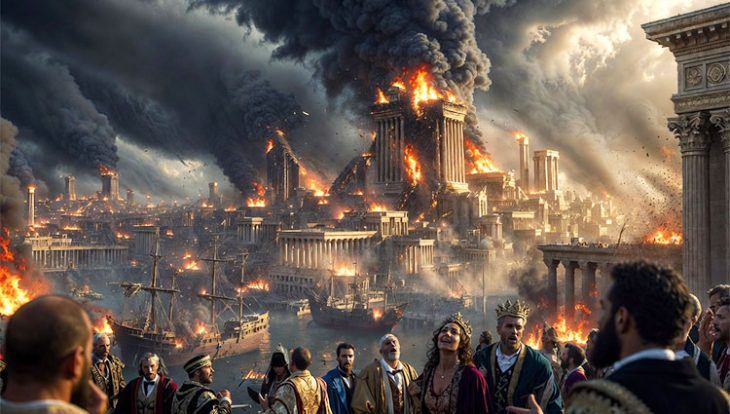
“The kings of the earth will weep and lament… and the merchants and every shipmaster and passenger and sailor were crying out, weeping and mourning, saying, ‘Woe, woe, the great city, in which all who had ships at sea became rich by her wealth, for in one hour she has been laid waste.'” (Revelation 18:9-19)
In 1981, the rock band Journey released a song written by Steve Perry and Jonathan Cain titled “Who’s Crying Now?” That question could well be the theme chorus for the kings and merchants of the earth who will weep and lament when Babylon the Great is consumed in a single day toward the end of the Tribulation (Revelation 17 and 18).
Perhaps an even more appropriate lyric would be “Who’s Sorry Now?” as sung by Connie Francis in 1957. Speaking of warnings ignored and payment come due, this song captures the righteous indignation God will pour out on Babylon and the sorrow that will consume those who have disregarded His warnings as they gloat in their riches and immoralities.
For many Christians who study Revelation, the dedication of two full chapters to the demise of this cryptic city or system is a tantalizing mystery. As such, there has been much speculation about the nature and location of what John describes as a woman riding a scarlet beast full of blasphemous names and herself bearing a mysterious name: “BABYLON THE GREAT, THE MOTHER OF HARLOTS AND OF THE ABOMINATIONS OF THE EARTH” (Revelation 17:5).
So, who or what is Babylon, and where is this horrific city or system located?
Who or What?
Most scholars readily agree that John’s description of Babylon as a woman is symbolic. Just as justice is sometimes represented by a blindfolded woman holding a pair of scales, or in America liberty is symbolized by a great statue standing in New York Harbor, John describes a woman holding a cup full of abominations and the unclean things of her immorality.
We have only to look to Proverbs to see Solomon personifying wisdom as a trusted sister, while temptation to sin is personified as a harlot (Proverbs 7–9). In His letter to Thyatira, Jesus also refers to a false prophetess who is leading His bond-servants astray as “Jezebel.” It is inferred that this is a symbolic name for a real person (probably not named Jezebel), but intentionally pointing back to the Baal-worshipping queen of Israel wed to evil Ahab.
Regarding “Mystery Babylon” in Revelation, there is wide consensus that instead of referring to a single individual, the name represents either a city or a world system. Several times in Revelation 18, Babylon is called a great and strong city (vv. 10, 16, and 18). No less than a strong angel from Heaven decries Babylon as a “great city” that will be “thrown down with violence” as a millstone is cast into the sea (Revelation 18:21).
Even so, a city can represent an entire empire or system—just as Washington, D.C. represents the United States (in terms of the government, the leadership, or the nation), New York has traditionally represented the capitalist system of America, if not the West in general, and Brussels represents the European Union. Destroying any of those individual cities would represent a grievous blow to the nation or system they represent, which is one reason why al-Qaeda was determined to strike both New York and Washington (the economic and political centers of America) on 9/11 in 2001.
In either case, the wickedness encouraged and propagated by that end-times locality or system infects all the nations of the earth. As John records, “For all the nations have drunk of the wine of the passion of her immorality, and the kings of the earth have committed acts of immorality with her, and the merchants of the earth have become rich by the wealth of her sensuality” (Revelation 18:3). Just consider some of the leading growth sectors of our economy today: “adult entertainment,” including gambling, pornography, drugs, and rampant hedonism. And that is with the restraining influence of the Church present to hold back some of the worst excesses. Can you imagine the immorality that will be unleashed—and the profits that will be generated by wicked means—after the Rapture?
When and Where?
For almost 2,000 years, debates have raged about the exact location of Mystery Babylon. Many early Christians assumed that John was referring to Rome but doing so in a cryptic manner to avoid additional persecution for prophesying its demise. As Rome came to represent the Roman Catholic Papacy (here again, with a city standing for a corrupt system or empire), Protestants were quick to adopt that interpretation as an indictment of the Papacy and the errors exposed in Catholicism. Bill Salus supports this position, emphasizing John’s use of the present tense in explaining that the harlot “is the great city, which reigns over the kings of the arth” and is judged to “avenge” the apostles and prophets (Revelation 17:18 and 18:20).
Later, other cities were considered, including London, Paris, and New York—always chosen for their prominence as the capitals (political or economic) of powerful nations or vast empires. Most of the prophecy teachers affiliated with Lamb & Lion Ministries reject this perspective. Instead, perhaps because so many locations were postulated in the past, many current Bible scholars believe that the Mystery Babylon John refers to might be a yet-to-be-determined location where the Antichrist will establish his global headquarters.
Some suggest it could be a rebuilt Babylon—the ancient city in Iraq that Saddam Hussein began to restore 40 years ago in an audacious effort to spur tourism to Iraq. Others have advocated for a new city somewhere in Europe or the Middle East and pointed to massive city-building projects that rival the original Babel in their hubris and audacity. (For instance, in 2021 Saudi Arabia announced that it would build a 100-mile-long city called “The Line” in the Arabian desert, with aspirations of housing nine million people but allowing no cars.)
Today, relatively few Bible prophecy experts advocate for Rome as the potential site of the fulfillment of Mystery Babylon. According to David Reagan:
Prior to this century, the consensus of opinion among Bible prophecy experts was that the “Mystery Babylon” of Revelation 17 and the “Babylon the Great” of Revelation 18 were both references to Rome. Today, that opinion has radically shifted, and the consensus now is that these terms refer to ancient Babylon. Accordingly, these experts argue that Babylon will soon be rebuilt. This is the reason that Tim LaHaye, in his “Left Behind” series of books, presents Babylon as the capital city of the Antichrist’s world kingdom.
Terry James and Al Gist share that sentiment, along with Mark Hitchcock, who says, “I take the view that it’s a literal rebuilt Babylon in the future.”
The Power Behind It All
There can be little doubt the Babylon that John was describing will be the seat of the Antichrist’s power. Pointing to that final global autocrat, Isaiah prophesied that the “king of Babylon” will be an oppressor of unprecedented ruthlessness (Isaiah 14:1-17). And, as Ed Hindson noted, “It’s obvious in the book of Revelation that John portrays Babylon, whatever he means by that, as the Kingdom of the Antichrist—the ungodly world system of the last days that controls the world economy.”
It is also obvious that this single city has influence that appears to exceed even the economic power of New York City, the political power of Washington, D.C., and the religious influence of Rome. That is why God orders the city’s destruction by a supernatural outpouring of His wrath, and why the kings and merchants cry and lament so bitterly at its loss.
For that reason, we believe that, like many other prophecies, the characteristics of Mystery Babylon are evident in various cities and systems today—just as they were in John’s day. However, that leads to the question: What is a city? It is more than a location on a map, a conglomeration of buildings, or even a community of inhabitants. Cities come to have a culture and influence that transcend all of those outward appearances. And just as ancient Babylon (and Babel before it) came to represent a willful rebellion and embrace of wickedness in the eyes of the Lord, Mystery Babylon may very well represent the ungodly, reprobate, and rebellious system of the Antichrist.
Do we believe the Antichrist will rule over his global empire from a great (in human eyes) city somewhere in the Middle East? Yes. Do we believe that the city will be destroyed in a single day as described in Revelation 18? Again, yes. We believe the crying and sorrow of kings, merchants, and all those who reveled in the sinful system she represents indicates that something far more entrenched and malign will finally be laid waste. Hubris and rebellion had inspired Nimrod to build cities in Shinar and Assyria.He and his men sought to “build for [themselves] a city and a tower whose top will reach into heaven.” Likewise, Sodom and Gomorrah flaunted their exceedingly great wickedness before the Lord. So too will the Antichrist build for his own pride and glory a city from which to rule over his global empire.
In the end, Nathan Jones’ plain-sense bottom line about Mystery Babylon: “Whether it’s Rome or a rebuilt Babylon, we don’t know, but the city will collapse as God attacks the Antichrist capital here on Earth.” The capital city of the Antichrist—Satan’s personally possessed and exalted man—will be obliterated. As David Reagan added:
It doesn’t really make any difference whether the Antichrist will reign from Babylon, Rome, New York City, or some other city. Regardless of which city it might prove to be, Almighty God is going to destroy the city, its king, and all its sinful activities in one hour of one day (Revelation 18:8-10). The point is, that regardless of the true identity of Babylon, Jesus is going to triumph, and we, the Redeemed, are going to win in the end.
We couldn’t have said it any better! So, knowing that King Jesus will be victorious over all His enemies, still your heart, dry your tears, let go of your anxious thoughts, and keep your eyes lifted up, for our Redemption is drawing near!