
[Note: Our contributing guest author, Mottel Baleston, leads Messengers Messianic Jewish Fellowship.]
As we await the Rapture of the Church and the subsequent Second Coming of Jesus Christ, there are certain clues or foreshadowings woven into the narrative of His First Advent that offer reassurance to the faithful.
Then, as today, there had been a long period of relative silence from Heaven. Amos’ prophecy about a “famine for the word of God” seemed to play out after the Old Testament canon was closed. For hundreds of years, the promise of consolation for Israel seemed to many a distant or fading hope.
The same is true in our own day and age. Echoing the sad prophecy of Peter, some professing Christians openly scoff at the idea that Jesus is returning or deny outright that His coming is imminent or soon (2 Peter 3:3-4). Just like the House of Israel, the Church has seen far too many false shepherds arise and lead God’s people astray. And governments throughout the world (and even in the formerly Christian West) have become hostile to the truth of the Gospel—and the prophesied arrival of the King.
For most Christians, Christmas is a time of deep reverence and warmth. It rivals Resurrection Sunday as the singular moment when extended commemorations and family traditions combine in a holiday even the secular world celebrates. But what can Jesus’ First Coming tell us about His second? Let’s find out.
Timing
“When the fullness of the time came, God sent His Son…” (Galatians 4:4)
If the forlorn people of Israel could have voted on the timing of the Messiah’s arrival, they certainly would have exercised that option long before He actually came. Whether during various famines or calamities, the horrific siege and destruction of Jerusalem, the painful exile in Babylon, or the galling subjection to Roman rule, there were multiple time periods when the House of Israel longed to be delivered.
But God the Father did not send forth His Son during any of those moments. He waited until about 400 years after the Old Testament canon was complete. He allowed Israel to endure a famine for His Word—a spiritual wilderness of sorts. And He allowed Rome to sweep into the Promised Land to impose its own pagan control.
Likewise, we are approaching 2,000 years since Jesus walked on earth. The Gospel has gone out to the four corners of the world, but faith is beginning to wane as heresy and apostasy spread even in former Christian strongholds. Given the opportunity, most followers of Christ would have Him come now. And yet we wait.
God’s timing is not our own—and is not subservient to our wishes. Instead, His ways are above our ways. And His reason for waiting is a function of His love and mercy: “He does not wish for any to perish, but for all to come to repentance” (2 Peter 3:9).
As eager as we are (and I am), perhaps our urgency to see the perishing saved while there is still time should reflect more of God’s own heart.
Location
There is a great deception being perpetrated in the world today. Anti-Israeli propaganda has convinced many people that the Jews have no claim on the Promised Land the Romans renamed Palestine.
Ostensibly, the instigator of this big lie is the Palestinian Arabs. They are so determined not to let a Jewish state coexist alongside them that they are willing to deny history itself. Their current president, Mahmud Abbas (who is in the 22nd year of his four-year term), earned a degree at a Soviet university. His dissertation was a long diatribe denying the Holocaust and claiming a direct link between Nazism and Zionism.
Many professing Palestinian Christians reject any use of the word “Israel,” insisting that the Promised Land is in fact Palestine and that there is no historic Jewish connection. Such misguided nationalism flies in the face of Scripture, yet college professors throughout the West have bought into this foolishness and are peddling it to radicalized students.
In spite of modern denials, God’s Word is clear. As documented in the four Gospels, Jesus was born in Bethlehem—an undeniably Jewish village within Judah. At that time, the Land of Israel was divided into several provinces, including Judea, Samaria, and the Galilee. And, although Jews had already been scattered throughout the empires of Babylon and Rome, the House of Israel recognized Eretz Yisrael (the Land of Israel) as its ancient home.
Jesus was born in a Jewish town to a young Jewish girl who was betrothed to a Jewish man. He grew up following Jewish traditions—from the offering of doves when He was first presented at the Temple to His observance of Jewish feasts to His bar mitzvah. And, when He comes back, He will not appear in New York City, or Washington, or Paris, or London. He will return to Jerusalem in the Land of Israel.
Witnesses
Prophecy scholars like to debate one aspect of the Rapture. We know that all Church Age believers (both living and dead) will rise to meet Him in the air. The dead will rise first, but we will all be changed in the twinkling of an eye. The question some pose is whether the world at large will see Him at that moment. I am strongly inclined to think they will not.
When Jesus came the first time, He did not appear to Caesar or Herod. He was not born in a palace or announced by a Judean town crier. The only witnesses to His birth were Mary and Joseph. Shortly thereafter, humble shepherds from the surrounding hills wandered in to see what an angel had announced.
Within a few days, Simeon and Anna beheld Him at the Temple. And at some point in the next several months (likely before He was two years old), Magi arrived from the East seeking to meet and worship Him. Their arrival upset Herod mightily—and all Jerusalem with him—but the masses did not see Jesus or recognize His anointing until He began His ministry almost 30 years later!
Why did God choose to send His Son into the world incognito? Why did He ordain that the news of Jesus’ birth would not rock the world immediately, but only later? We may never have answers to those “why” questions, but the dearth of witnesses suggests that the world will not see Him come for His own at the Rapture.
The repercussions of His arrival in the air (and the departure of the Church) will be earthshaking, but it may take days, weeks, or months for the average person to realize that the Rapture changed everything.
Prophetic Fulfillment
The prophecies fulfilled at Jesus’ First Advent have been categorized many times over. From His birth in Bethlehem Ephrathah (Micah 5:2), to His sojourn with His parents in Egypt, to the slaughter of male children around Bethlehem, to the humble nature of His birth. And those are just a few of the prophecies dealing with His birth and early life.
Dr. David Reagan has identified 109 distinct prophecies fulfilled in the life of Jesus Christ following His first coming. Some of them are mentioned twice in the Old Testament, but every one was fulfilled. Peter drove that point home in his first sermon following Pentecost. Standing before a crowd of Jews gathered from all the nations where they had been scattered, Peter cited Joel, David (in Psalm 16 and 89), and Samuel. Confronted with the undeniable evidence of fulfilled prophecy, many in the crowd were pierced to the heart. Luke records that 3,000 were added to the Church that day (Acts 2:41).
Isaiah 9 reads like a punch list of prophetic details:
- The land of Zebulun and Naphtali will be glorious once again (these tribal regions surrounded the Galilee where Jesus began His ministry and performed most of His miraculous works).
- People who walked in darkness in a dark land will see a great Light.
- A Child will be born.
- A Son will be given.
- The government will rest on His shoulders (all authority given to Him).
- He shall be called Wonderful Counselor, Mighty God, Eternal Father, Prince of Peace.
But not all of the prophecies Isaiah recorded have been fulfilled yet. In the fullness of time, the Messiah will:
- See an unstoppable expansion of His reign and of peace on Earth.
- Rule from the throne of His father David.
- Establish justice and righteousness throughout the world.
Because of varying descriptions of Messiah and His mission in the Old Testament prophecies (a “suffering Servant” rather than a “conquering King”), Jewish rabbis eventually concluded that there would have to be two different Messiahs, each one taking up one of those roles. The suffering servant was named Messiah ben Joseph (Moshiach ben Yoseph), in reference to the fact that Joseph (the 11th son of Jacob’s 12 sons) suffered at the hands of his brethren. The conquering King Messiah was expected to be Messiah ben David (Moshiach ben David), because King David was a military conqueror. While the rabbis correctly understood the two very different roles of Messiah, what they missed was the fact that both roles would be taken up by the same Messiah—initially at His First Advent as the Lamb and then following His Second Coming as King and the Lion.
Gabriel’s Prophetic Message
Similarly, when Gabriel appeared to Mary, his announcement of the Messiah contained startling detail. Some of those prophesied promises have already been fulfilled:
- Mary did conceive, even though she was a virgin.
- She bore a son as her firstborn.
- She and Joseph named Him Jesus.
- He was recognized as great and called Son of the Most High—by people and demons alike.
But, like the prophecies in Isaiah, some of what Gabriel foretold has yet to come to pass:
- Jesus has not yet been installed on the throne of His father David.
- He is not yet exercising His reign over the House of Jacob forever.
- His kingdom exists as an “already, but not yet” reality; His will is done in Heaven, but is ot yet imposed on Earth. (We know that He works all things together for good, but at present Satan clearly still has authority on Earth; see Ephesians 2:2).
With the advantage of hindsight, Gabriel’s message was obviously sweeping in its scope. It addressed both the immediate arrival of the Messiah in the First Advent and His glorious Second Coming. We see those events as separated by over 2,000 years, but from a heavenly perspective they are intrinsically linked.
Because Christ came as a babe, lived as a man, and died as a savior, the promise of Immanuel (“God with us”) is sealed. The ultimate fulfillment of that prophecy will occur at the Second Coming, when Jesus returns to live among His people and reign as King of kings and Lord of lords.
Light Pierces the Shadow Years
C.S. Lewis referred to our existence on Earth as “shadowlands.” By that, he meant that reality as we know it is just a pale, temporary reflection or “shadow” of what God has in store for those who are His. Even our sufferings and joys should be measured against the greater glory that awaits us.
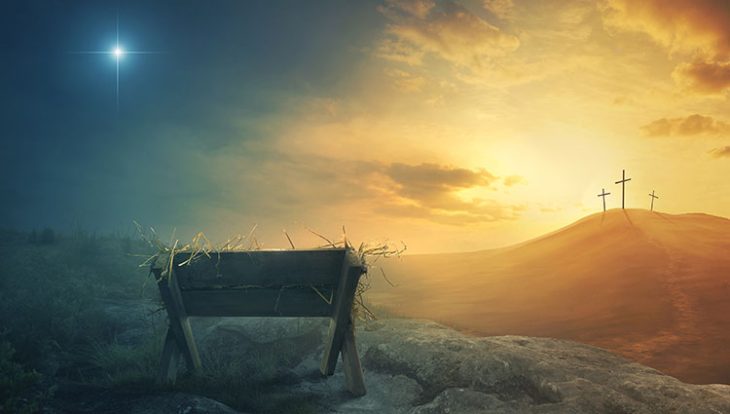
For over two millennia, the world has endured shadow years. We live in the shadow of the cross—and the shadow of what lies ahead. From the moment we place our trust in Jesus Christ, we lay claim to a promise of “joy inexpressible and full of glory” far beyond what our minds can even comprehend (1 Peter 1:8; 1 Corinthians 2:9).
Christmas offers us a brief foretaste of what is coming. For one night, “all is calm, all is bright.” Peace on Earth becomes a living hope as well as a prayer, and even hardened hearts tend to thaw just a bit.
This year, take time to ponder as Mary did over God’s unfathomable gift to mankind. Consider the love that motivated Him to send His only begotten Son into a dark and desperate world, knowing that most of the people He came to save would reject and vilify and crucify Him.
Take a lesson from the shepherds. If you have found the Messiah as He was foretold, make known what has been revealed to you about Him. Demonstrate the wisdom of the Wise Men and worship Him with great joy. Lift up your eyes and raise your voice like Simeon to bless God because you too have encountered His salvation: “A light for revelation to the Gentiles and the glory of [His] people Israel” (Luke 2:28-32).