
[Note: This article was taken by permission from Brock and Bodie Thoene’s book Why a Manger? The Thoenes are a gifted husband-and-wife writing team known for their biblically-accurate historical fiction. The title of this article cites an oft-stated Thoene truism regarding the beauty and scope of God’s Word: “everything means something.”]
Why Mary?
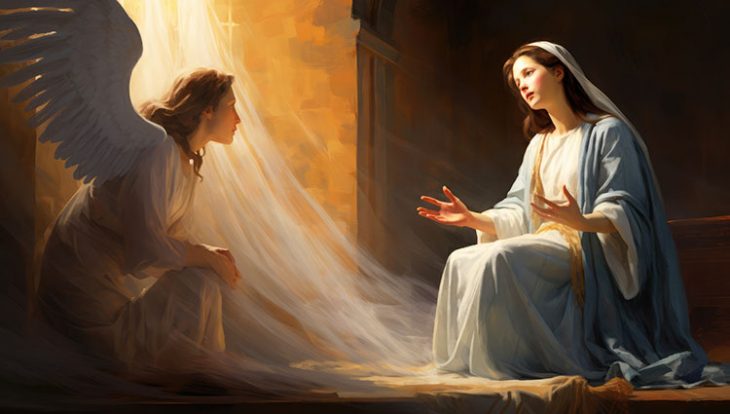
“In the sixth month, God sent the angel Gabriel to Nazareth, a town in Galilee, to a virgin pledged to be married to a man named Joseph, a descendant of David. The virgin’s name was Mary.” (Luke 1:26-27, NIV)
When confronted with life-changing words from an angelic messenger, Mary’s response was not only immediate belief, but action. She traveled to see pregnant Elizabeth!
Mary, whose name means “bitter rebellion,” would carry the promised Son of God in her womb. But, unlike Eve, Mary was no rebel. She was favored by the Lord above all women. He had searched her heart, found no bitterness there, and declared her worthy. Her humble acceptance of her role in God’s eternal plan displayed a faith like Abraham’s.
When the angel appeared to Mary, he brought her a word from God. Because of her belief, she received the Word into her spirit. Then, nine months later, that Eternal-Word-Made-Flesh dwelt among us. Such a miracle!
That miracle continues today. Receiving God’s Word into your spirit and believing in the power of the Holy Spirit results in having God’s Word present and alive in you.
Why Joseph?
“All this took place to fulfill what the Lord had said through the prophet: ‘The virgin will be with child and will give birth to a son, and they will call him Immanuel—which means, “God with us” ‘.” (Matthew 1:22-23)
Mary and Joseph were both descendants of David, but through different ancestors. Joseph’s ancestor, King Jeconiah, was cursed for turning from the Lord, and thus the Messiah could not come from his lineage. Mary’s line from David remained blessed. So each played a different role in redemption. Mary would bring forth the Redeemer. Joseph was among those in David’s lineage who would be redeemed.
Joseph—so ordinary, but gifted with humility and faith—would play a pivotal role not only for his generation, but for all generations to come, throughout the world and for all Eternity! His life is proof that God uses ordinary people to accomplish His plans.
Why Bethlehem?
“He tends his flock like a shepherd; he gathers the lambs in his arms and carries them close to his heart.” (Isaiah 40:11)
Ask anyone who celebrates Christmas where the Christ Child was born, and most will name Bethlehem. Carols memorialize its fame. Many could also explain why dusty, insignificant Bethlehem was chosen for such an important event. In Hebrew, Bethlehem means “House of Bread.” It was prophesied that the Messiah, “the Bread sent down from heaven to feed the souls of mankind,” would be a descendant of King David. He would also be born in the same city where David, the shepherd-king of Israel, was born—Bethlehem.
“You, Bethlehem Ephrathah, though you are small among the clans of Judah, out of you will come for me one who will be ruler over Israel, whose origins are from of old, from ancient times.” (Micah 5:2, NIV)
John the Baptist called Jesus not only the “Son of God” (John 1:34) but also the “Lamb of God” (John 1:36).
The Firstborn Lamb of God would sacrifice His Life to atone for the sins of all—a one-time perfect sacrifice, offered by the Father God Himself.
Where else would “the Lamb of God, who takes away the sin of the world” (John 1:29) have to be born if not Bethlehem, among the sacred Temple flocks?