
The Book of Revelation opens with great encouragement and unflinching affirmation of Jesus Christ as Lord of all. He is “the faithful witness, the firstborn of the dead, and the ruler of the kings of the earth” who loves us so much that He “released us from our sin by His blood” (1:5). The book is presented as His own revelation, “which God the Father gave Him to show His bondservants the things which must soon take place” (1:1).
Grace and peace are offered “from Him who is and who was and who is to come” (1:4).
John faithfully recorded the vision he had on the island of Patmos as well as the seven letters Jesus dictated for distribution to seven churches in Asia (modern-day Turkey) late in the first century. Chapter 4 opens with a “rapture in type” as John is told to “Come up here” and whisked away into Heaven (4:1). The throne room scene climaxes when a sealed book is produced that “no one in Heaven or on the Earth or under the Earth was able to open” (5:3)—until Jesus steps forward to take the book and open the seals.
John’s description of Jesus conveys the perspective of fulfilled prophecy. Jesus is called “the Lion that is from the tribe of Judah,” “the Root of David,” “a Lamb standing, as if slain, having seven horns and seven eyes, which are the seven Spirits of God” (5:5-6). The assembled host of Heaven rightfully breaks out into song and worship, celebrating the beloved Son of God, very God of very God. Their chorus should fill the heart of every follower of Christ who longs for His coming:
Worthy is the Lamb that was slain to receive power and riches and wisdom and might and honor and glory and blessing. To Him who sits on the throne, and to the Lamb, be blessing and honor and glory and dominion forever and ever. (5:12-13)
If the book of Revelation ended at chapter 5, we would have ample reason to praise the Lord. His encouragement and admonition to the Church were clearly conveyed in chapters 2 and 3, and His worthiness to receive everlasting praise was affirmed once again. We could rest assured that His plan for the ages is proceeding according to His will and serve knowing that we will eventually join the throng gathered around His throne in Heaven.
But Jesus’ charge to John in 1:18 was to write the things which he had seen (chapter 1), the things which are (chapters 2 and 3), and “the things which will take place after these things.” With that revealed outline, what follows the throne room scene of chapters 4 and 5 is clearly meant to offer a glimpse into the not-too-distant future. With that in mind, if it was important enough for Christ to choose to reveal what lies ahead in human history, we can rightfully understand that He expects us to heed His words as we would any other.
Lest there be any doubt about His expectation to that effect, we are told just that in chapters 1 and 22—“Blessed is he who heeds the words of the prophecy of this book” (22:7). The urgency of our heeding is made clear at the outset of the book: “for the time is near” (1:3).
A Divergence of Options
The book of Revelation is clearly addressed to a specific audience: the bondservants of Jesus Christ (1:1). The initial recipients were the Christians in the Seven Churches listed in the text: Ephesus, Smyrna, Pergamum, Thyatira, Sardis, Philadelphia, and Laodicea (1:11). The specificity of the letters obviously touches on attributes (both positive and negative) of those particular churches. But the affirmation and/or reproach each one was given finds application in local bodies of Christ throughout the Church Age—and even to time periods within the Church Age.
It is hard to envision non-believers finding application to their situation in the first five chapters of Revelation, other than a general desire to be among those from every tribe and tongue and people and nation who have been purchased for God by Christ’s blood and given a promise to reign alongside Him on the Earth (5:9-10).
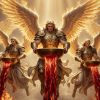
But in chapter 6, the narrative takes a dramatic turn. As one after another seal is broken, the action in Heaven unleashes a great calamity on Earth. No longer the meek and mild suffering Servant of Isaiah 53, Christ is now the Worthy One who breaks the seals that send forth riders and catastrophes to inflict great suffering on the Earth. This reality alone does not align with the false prophets of prosperity who proclaim that Jesus would never hurt a fly. The image here is of Jesus exercising the will of the Father to pour out judgment on an unrepentant world devoid of Church Age saints who have been swept up at the Rapture.
In a series of terrors that run through the Seal, Bowl, and Trumpet Judgments, the stark contrast presented in John 3:36 is glaringly apparent: those who believe in the Son are already glorying in the joy of eternal life with the Savior, while those who reject His offer of salvation experience the wrath that abides on them from the day they were conceived.
It is that contrast that presents the either/or, black-or-white, diametrically opposed options that every person faces during this life. It really is simple enough to be summed up in bumper-sticker starkness: “Know Christ, Know Peace. No Christ, No Peace.”
Those two statements may seem trite, but as my friend Paul Wilkinson would say, they convey a beautiful simplicity of options. With that in mind, let’s take a longer glance behind Door # 1 and Door # 2.
What’s a Seal?
John 6:27 provides the first reference to the seal of God. Jesus testifies that His disciples should not merely work for food that perishes, “but for the food which endures to eternal life, which the Son of Man will give to you, for on Him the Father, God, has set His seal.” The word that is translated “seal” is the Greek word sphragízō, meaning “to stamp for security, preservation, or attestation.” We can envision this as the impression of a signet ring in hot wax. In this context, Jesus was clearly affirming the Father’s attestation of His authority to forgive sin and bestow eternal life.
This is the type of seal that Matthew 27:66 indicates was used to seal the tomb of Christ: a seal of finality that no one but the rightful authority would dare to break. Paul uses this word metaphorically in Romans 15:28, 2 Corinthians 1:22, and Ephesians 1:13 and 4:30. Then, in 2 Timothy 2:19, he writes, “the firm foundation of God stands, having this seal, ‘The Lord knows those who are His,’ and ‘Everyone who names the name of the Lord is to abstain from wickedness.’ ” The Greek word in this case (sphragís) is a derivative referring specifically to the stamped impression, whether literally or figuratively.
The image of the “book” in Revelation 5:1, that is “written inside and on the back, sealed with seven seals,” conveys this exact imagery. Given our understanding of a “book” as a bound publication, a better translation would be a scroll, for John would have seen a written instrument not unlike a Torah scroll, but sealed (as with wax) seven times. For many years, the only way to ensure the unbroken security of a private communication was to use a wax seal. Without the original signet or stamp, any breach of the seal could not be counterfeited. And, if the original signer was a person of great power, it would have been unthinkable for an unauthorized person to break the seal.
Clearly, this is the context of Revelation 5 and 6. Nobody but Jesus Christ was found worthy to break the seals of the book/scroll held by God the Father. Only Christ had overcome so as to break the seals. Overcome what, a skeptic might ask? Death, by the power of His own authority.
The fact that Jesus is worthy evokes the praise I discussed already. But before the seals are broken and the consequences unleashed, the heavenly chorus praises Him for purchasing men who have been made to be a kingdom and priests to God (Revelation 5:10). And that realization brings us back to the Door #1 option available to all mankind: the seal of God.
In Part 2, we will compare and contrast those who are sealed for eternity and those who are sealed for wrath.