
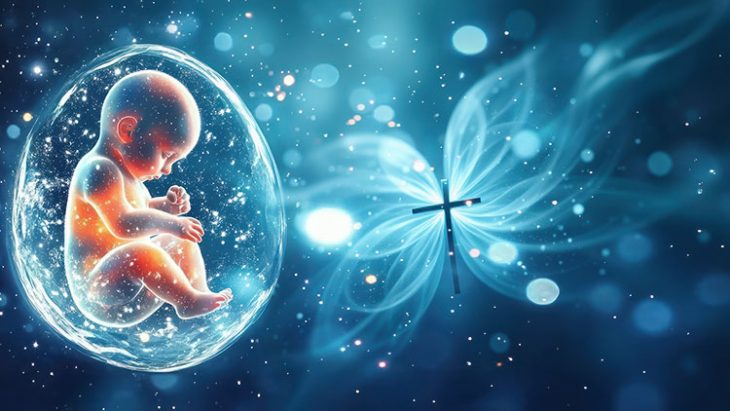
Have you ever watched a butterfly and marveled at its delicate lines and beautiful colors as it flits from flower to flower? The butterfly is one of God’s most captivating and graceful creatures.
And yet, your butterfly hasn’t always looked so lovely; why, it didn’t even look like a butterfly! That’s because this winged insect is in its fourth and final stage in a process called metamorphosis, a Greek word meaning “transformation” or “to change in shape.” The four stages in a butterfly’s life are:
- First Stage: Egg – A butterfly begins its life as a simple egg, laid on a plant by an adult female.
- Feeding Stage: Caterpillar – Bursting from the egg, the caterpillar, also called a larva, eats voraciously, shedding its skin 4-5 times to grow 100 times its size.
- Transition Stage: Pupa – Once the caterpillar is fully grown, it becomes a pupa by transforming itself into a chrysalis. Over a period of a few weeks to two years, the caterpillar exchanges its stubby features for long legs, colorful wings, springy antennae, and compound eyes.
- Reproductive Stage: Adult – Once the butterfly emerges from the chrysalis, it will often forego food in its sole mission to mate and lay eggs over the few weeks that it has left to live.
Each stage of metamorphosis provides a unique and limited point of view. For example, the egg cannot comprehend life on the move as a caterpillar. The caterpillar doesn’t know why it is so ravenously hungry. The pupa can merely wonder why it is growing new appendages. Only as an adult can the butterfly look back over its lifespan (if an insect can ponder) to marvel at how God transformed it from a helpless egg to a free-flying butterfly.
The Stages of Mortal Human Life
In this respect, have you ever considered that we, as humans, are much like butterflies? We, too, go through progressive stages of life, metamorphosing from one form to the next. And, as we are living in each stage, our knowledge of what life will be like in succeeding stages remains quite limited.
To better understand the concept of human metamorphosis, let’s walk through the stages of mortal life.
1. Prenatal Stage
The first stage of human life begins at conception and progresses through three major developmental phases over approximately 40 weeks, culminating in birth. During the germinal stage, the newly formed zygote contains 46 chromosomes and undergoes rapid cell division. It will implant itself in the uterine wall within 2 weeks.
The embryonic stage follows, lasting from weeks 3 to 8. The heart begins to beat, the neural tube gives rise to the brain and spinal cord, and the embryo receives nourishment via an umbilical cord.
As development enters the fetal stage, spanning weeks 9 to 40, the organs and tissues mature quickly, and the sex organs become distinguishable. By week 10, the major structures are already in place, and by week 37, the fetus can survive outside the womb. At around 6 pounds and approximately 18 inches long, we are now prepared for birth and the second stage of human life.
2. Childhood Stage
The childhood stage begins at birth and continues through four major developmental periods. From birth to age 2, infants grow rapidly, develop motor skills and reflexes, begin forming language, and progress from rolling to crawling to walking while learning basic social and emotional patterns.
Between ages 2 and 6, preschoolers expand their language, thinking, and motor abilities. They begin to gain some independence and explore the world through imaginative play and social interaction.
During middle childhood, from 6 to 11, growth becomes steady, and cognitive skills become more complex. Children refine their sense of identity through school, accomplishments, and social norms. By age 7, the brain reaches its adult size, supporting more advanced problem‑solving.
Adolescence, spanning ages 12 to 18, is characterized by rapid physical changes called puberty. Teens deepen their search for identity beyond their families, marked by growing independence, strong peer influences, and increased risk‑taking.
3. Adulthood Stage
Adulthood begins when a person becomes fully independent yet continues to progress through three major developmental stages. In early adulthood, individuals ages 18 to 39 have reached peak physical maturity. Emotional, social, and cognitive growth continues with a focus on building relationships, families, and careers.
Middle adulthood, from 40 to 59, is marked by stable physical and mental functioning, increased productivity, and a growing awareness of aging, life goals, and personal commitments. During this period, people often reflect on their accomplishments and contemplate the direction their lives have taken.
Late adulthood begins at age 60 and is characterized by increasing physical challenges, including declining muscle mass, reduced bone density, and slower cognitive processing. This stage focuses on retirement, adapting to health changes, and confronting end‑of‑life realities.
The Stages of Immortal Human Life
Once a butterfly dies, it is no more. It ceases to exist. Humans, on the other hand, though we possess a mortal body and a beginning, are, in truth, immortal because God has given each of us a spirit that lives on beyond this mortal coil. The apostle Paul explained, “It is sown a natural body, it is raised a spiritual body. If there is a natural body, there is also a spiritual body.” (1 Corinthians 15:44).
When describing the differences between man and animals when it comes to mortality, famed Bible teacher Clarence Larkin described man as a “trinity,” or tripartite man, composed of a body, soul, and spirit (1 Thessalonians 5:23; Hebrews 4:12). The body of man, with its five senses (sight, hearing, smell, taste, and touch), is that part which connects us to the physical world. The soul, in essence, the actual “person” of man, is likewise composed of three parts (the mind, will, and emotions). Our human spirit, the part animals lack, is also composed of three parts (the conscience, the fellowship, and the intuition).
Because of the corrupting influence of sin, the human body will perish. But once we experience Christ’s salvation, the spirit, soul, and body begin regenerating. “For as in Adam all die, so also in Christ all will be made alive.” (1 Corinthians 15:22). Chinese evangelist Witness Lee explained: “The transfiguration of our body is the ultimate consummation of God’s salvation. In His salvation, God first regenerated our spirit (John 3:6), now is transforming our soul (Romans 12:2), and consummately will transfigure our body, making us the same as Christ in all three parts of our being.”
So, while the Christian renews their spirit at justification, and the soul through the ongoing process of sanctification, the body awaits glorification through the resurrection. As Lee added, “Thus, in God’s full salvation, not only is our body freed from the foreign elements of sin and death, but even more, it is saturated with the divine glory and conformed to the body of His glory.” This means that after the mortal body dies, people experience two additional life stages in reaching their final form.
Does this concept of human metamorphosis surprise you? It does to most people who believe that death is the finale to human life. And yet, the Bible teaches us that death is not the conclusion of a person’s life, but rather, merely a transition to our eternal, immortal forms in a forever state.
So let us continue our exploration of human metamorphosis, beyond our three mortal stages and into our two immortal stages.
4. The Intermediate Stage
Upon death, those who are saved are immediately ushered by God’s angels into the presence of Jesus Christ in Heaven (Luke 16:22; 23:43). And for those who are not saved, they are instead ushered into a prison called Torments, also called Hades or Sheol (Luke 16).
God never intended for humans to exist for eternity without physical bodies, mythically floating around on clouds as disembodied spirits. Rather, our spirits receive what theologians call an intermediate spirit body. These intermediate bodies are physical, tangible, and recognizable. For example, when Elijah and Moses appeared at the Transfiguration, Samuel appeared to Saul, and the Tribulation martyrs stand before the throne of God wearing white robes; in all these examples, they clearly possessed physical bodies, as spirits have no need for clothing.
While humans never remain bodiless, neither are our souls left unconscious. We remain conscious after death. We learn this in Christ’s account of the Rich Man and Lazarus in Luke 16. Both men died and are described as dwelling in bodies that could thirst, see, and talk. They existed in a fully conscious state and were never dormant in soul sleep. Only the earthly, mortal body remains “asleep” in the grave, awaiting resurrection.
5. The Glorified Stage
Once the Rapture occurs, the earthly bodies of the dead in Christ will be resurrected and merged with their intermediate body for our final stage of metamorphosis—the glorified body (1 Corinthians 15:35-56). And for those in Christ who are still alive when the Rapture occurs, their earthly body will be instantly transformed into their glorified body. This will be the only generation in history to avoid death.
First Corinthians 15:42-50 describes our glorified bodies as the body that is sown perishable, meaning it can be destroyed; is raised imperishable, meaning it cannot be destroyed. It is sown in dishonor, in that our sin weighs us down like we are slogged in filth, but it is raised in glory, meaning in purity. It is sown in weakness, in that we get sick and tired, but it is raised in power. We are sown with a natural body, but will be raised with a Holy Spirit-powered body.
Best of all, we will “bear the likeness of the Man from heaven,” whom we know is none other than the resurrected Jesus Christ (1 Corinthians 15:49 NKJV). His resurrection provides the template for mankind’s own resurrection. For when Jesus returns, it is He “who will transform the body of our humble state into conformity with the body of His glory, by His working through which He is able to even subject all things to Himself” (Philippians 3:20-21).
It is important to note that those who died in rebellion against Christ will not experience this resurrection to glory. Instead, they will be resurrected to shame at the Great White Throne Judgment after the Millennial Kingdom has ended (Revelation 20:11-15). Having never been regenerated by Christ’s salvation, they remain in their corrupted state, and so will be cast body, soul, and spirit into the Lake of Fire to face physical and spiritual suffering—eternal death.
Will you face this final stage of your human metamorphosis with eternal life… or eternal death? “Choose for yourselves this day whom you will serve… but as for me and my house, we will serve the Lord” (Joshua 24:15).




I wonder what will surprise us when receive our glorified body? From what we know, it will be a radical transformation. I’m assuming telepathy, telekinesis, and teleportation at a minimum. What a glorious surprise!
Beautiful assumptions, Brother and many more !!
GOD IS FILLING ALL THINGS. THE FULLNESS OF TIMES HAS ARRIVED! PRAY FOR THE GIFT OF DISCERMENT.
Tremendous article, Nathan. Somehow it completes the cycle of thinking for me and fills in some gaps. This has long been a picture of spiritual growth for me. Sometimes in the struggles of life we want to help that metamorphosis process along thinking if we can only set that person free from their struggles all will be well, but sometimes we actually set back or enable them to stay where they are and delay God’s beautiful work. God forgive! We need prayerful discernment always.
– Everyone who has died to date (both saved and unsaved) have physical bodies.
– The bodies (and souls) of the unsaved are in Hades.
– The bodies (and souls and spirits) of the saved are with Jesus in Heaven.
– At the rapture, the bodies of the saved (both the living and the dead) will be transformed into glorified bodies.
– At the Great White Throne judgment, the bodies of the unsaved will NOT be transformed but will be cast into the Lake of Fire.
When Jesus was still on earth following His resurrection, He clearly had a physical body because people touched Him and He ate food. He was still in this same body when he ascended into Heaven. I assume that when He got to heaven He received His glorified body.
Does all of this sound right?
Sounds doctrinally sound. Though, considering the supernaturally sudden appearances of Jesus before He ascended, He must have been in His glorified body, as He’d already resurrected.
Great article to read at this time. I don’t know how anyone could ever deny the existence of God after we see his creation, plant, animal life, seasons, wonders in the sky, and miracles. He is the maker of all things, his abilities far exceed man or any other entity.
John 1:1. In the beginning was the Word, and the Word was with God, ad the Word was God. He was God in the beginning. Through him all things were made; without him nothing was made that has been made. Look at the stages of life we go through. Wonder how delightful our life will be when we are with Jesus, (for we will be like him.)
The Glorified state once the Rapture occurs, we will be in the final metamorphosis, the glorified body. 1 Corinthians 15:35. For those in Christ who are still alive when the Rapture occurs, their earthly body will be instantly transformed into their glorified body. This will be the only generation in history to avoid death. We are sown with a natural body but will be raised with a Holy-Spirit powered body. Nice thoughts to have as we near completion of all things. Lamplighter magazine has some relevant information.
A devout Christian friend believes we will have to go through the tribulation. He said the First century Christian’s suffered and died for their faith as are people in our time also dying for their belief in Jesus. He questions why would we be taken out when others are dying. I was a proponent of the pre-Trib rapture but now I’m not as sure. I know that there are pre, mid and post trib rapture beliefs. Which view is correct? Thank you.
Lisa, let’s first define “Tribulation,” for there’s tribulation, and then there’s THE Tribulation. How one defines tribulation is often tied to where they’re coming from. We’re obviously not talking about First World problems here. The rest of the world defines tribulation much more severely. These are the severe trials and afflictions that much of the world suffers from on an ongoing basis. Then, there are the Christians, who live under an extra level of persecution. For Jesus warned, “If they persecuted Me, they will also persecute you,” therefore “In the world you will have tribulation.” The world hates Jesus and His moral law, and so will of course also hate and persecute His followers. But, when talking about tribulation, as Bible prophecy describes, we’re not talking about the inevitable day-to-day sufferings we all share caused by Satan and our fellow man. Rather, prophecy is talking about an event – The Tribulation.
The Bible makes it clear that the Tribulation is God’s wrath poured out upon the unbelieving world, and not for those who are saved from Christ’s resurrection to the Rapture – called the Church. True believers in Christ during the Church Age, represented by the Church of Philadelphia, are promised in Revelation 3:10, “Since you have kept my command to endure patiently, I will also keep you from the hour of trial that is going to come upon the whole world to test those who live on the earth.” Paul states in 1 Thessalonians 1:10, “and to wait for his Son from heaven, whom he raised from the dead—Jesus, who rescues us from the coming wrath.” He also states in 1 Thessalonians 5:9, “For God did not appoint us to suffer wrath but to receive salvation through our Lord Jesus Christ.” Romans 5:9 states, “Since we have now been justified by his blood, how much more shall we be saved from God’s wrath through him!” Ephesians 5:6 states, “Let no one deceive you with empty words, for because of such things God’s wrath comes on those who are disobedient.” Colossians 3:4 states, “When Christ, who is your life, appears, then you also will appear with him in glory.” Again and again, Scripture states the Church is not meant to endure God’s special time of wrath.
For information on why we believe the Pre-Tribulation Rapture is the best argument for the timing of the Rapture, please watch my sermon on the subject at https://christinprophecy.org/programs/the-rapture-of-the-church/, check out these articles on our website at https://christinprophecy.org/articles/why-i-believe-in-a-pre-tribulation-rapture/ and https://christinprophecy.org/articles/the-origin-of-the-concept-of-a-pre-tribulation-rapture/ and our “Christ in Prophecy” shows posted at https://christinprophecy.org/programs/rapture/. We also have three short Inbox videos explaining the Rapture and its timing: http://christinprophecy.org/programs/the-inbox-20-is-the-rapture-and-second-coming-the-same-event/, http://christinprophecy.org/programs/the-inbox-21-why-do-i-believe-in-a-pre-trib-rapture/, and https://christinprophecy.org/programs/the-inbox-5-what-are-some-misconceptions-about-the-rapture/.