

When I was younger, like most people, I operated under the misconception that angels all look alike. In my mind’s eye, they stood in uniform, like a tray of gingerbread men coming out of the oven, or like white-clad clone troopers marching through a Star Wars battle scene. That imagery may have captured my mind because, growing up, I leaned heavily on the classically illustrated children’s books from my parents’ generation. They depicted celestial beings with a mid-twentieth-century Americana cultural uniformity. These angels were often portrayed as Caucasian men with curly blond hair, sporting two feathery white wings, floating a golden halo over their heads, possessing a fairly stoic demeanor, and dressed in white robes reminiscent of the ancient Roman toga.
Yet one of the first angels the apostle John described in the book of Revelation was “a strong angel proclaiming with a loud voice” (Revelation 5:2 NKJV). Clearly, John saw characteristics that set this angel apart from the myriad others he’d just encountered. This strong angel, for example, was both strong and loud. Was this angel more shredded than the other angels? Did he sport huge muscles like Lou Ferrigno of Hulk fame—a Mr. Universe compared to the others? Maybe. Or did he lift heavy weights like a Russian powerlifter, or even whole planets like the mythological Atlas? John never described such feats. And what about loud? Was his voice louder than all the others?
Angels differ widely in appearance and abilities. So let’s explore three angelic classes that highlight the uniqueness of these celestial beings. First, there are the heavenly proclaimers—the Seraphim. Second, the mighty wheelmen—the Cherubim. Third, the fire wielders—the Fire Angels. This sampling will show that angels are not photocopies but are as different from one another as human beings are.
The Seraphim
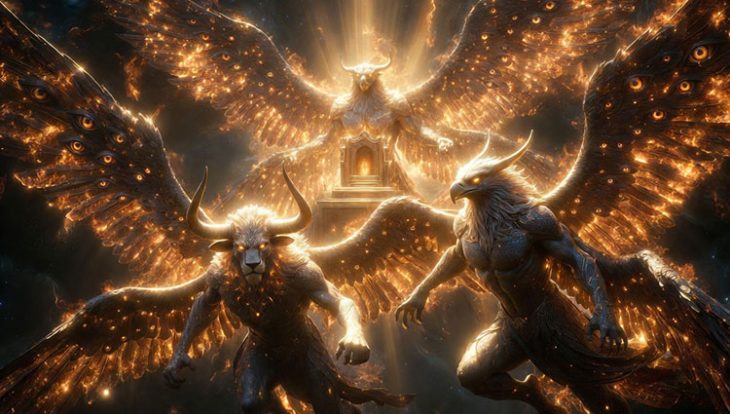
Imagine a scene of unimaginable beauty, such as a golden sunset over a snow-capped mountain peak. That’s kind of what John must have felt when he encountered the Four Living Creatures in God’s throne room. Gaping, John wrote, “And in the midst of the throne, and around the throne, were four living creatures… The first living creature was like a lion, the second living creature like a calf, the third living creature had a face like a man, and the fourth living creature was like a flying eagle. The four living creatures, each having six wings, were full of eyes around and within” (Revelation 4:6-9).
The Mighty Worshippers
Here we meet a class of angels called Seraphim, who, upon gazing at the radiant beauty of the living God day after day, never tire of bowing and praising His name: “Holy, holy, holy, Lord God Almighty, who was and is and is to come!” (Revelation 4:8). These angels love to hear the worship of the Lord, whether from angelic choirs or from the proprietary song sung by the 144,000 Jewish evangelists (Revelation 14:3).
When not engaged in worship, they carry out God’s judgments, such as handing the seven bowl judgment angels their liquid instruments of wrath (Revelation 15:7). Whenever you see the Seraphim throughout the Revelation narrative—and it’s frequent—they are praising God and carrying out His divine will. They always get the final “amen.”
The Burning Ones
These Seraphim look upon the magnificence of the One on the Throne, not with just one set of eyes, but with hundreds covering their entire bodies. And their wings! We tend to think all angels have two wings, but the Seraphim have many more, six to be exact: “with two he covered his face, with two he covered his feet, and with two he flew” (Isaiah 6:1-6).
John attempted to describe these four unique angels. They resembled the grand sphinxes that had historically guarded the Egyptian pyramids. John might have thought of the Seraphim as the Burning Ones, the legendary winged serpents that protected the Egyptian pharaohs’ thrones.
Each Seraphim possessed a different face. One portrayed a lion, another an ox, another a man, and another an eagle. John naturally found it hard to classify these angels, so he simply called them the “living creatures.”
Various theologians over the years have attempted to find symbolic meanings in their different countenances. Perhaps the lion’s face symbolizes majesty and omnipotence, the ox represents faithful labor and patience, the man signifies intelligence, and the eagle stands for supreme sovereignty. Or maybe the Seraphim represent the leaders of the different animal domains: the lion as the leader of the wild animals, the calf as the leader of domestic animals, the man as the leader of humankind, and the eagle as the leader of the kingdom of the flyers.
Others believe the Four Living Creatures represent Christ’s attributes as shown in the Gospels: in Matthew as the lion of the tribe of Judah, in Mark as an ox serving faithfully to Yahweh, in Luke as God in human form, and in John as an eagle soaring as the divine Son of God. Whatever the Four Living Creatures may symbolize, they stand out as fantastical yet genuine angelic beings—beings that every Christian will one day gaze upon in awe.
In the next article, we will stand amazed by the mighty Cherubim and the Fire Angels!
Resource
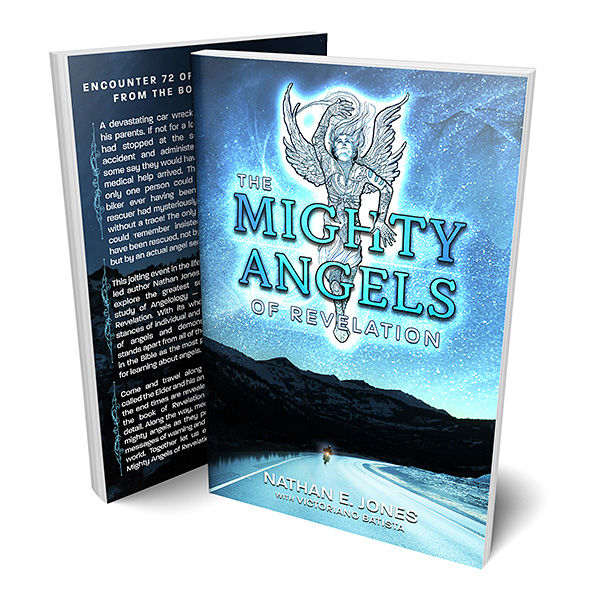
Encounter 72 of God’s mightiest angels as they proclaim God’s messages of warning and hope to a lost world throughout the book of Revelation! Order your copy of the book The Mighty Angels of Revelation by Dr. Nathan Jones today!





This is such a clear explanation of the Seraphim. To visualise them is very difficult. To remember they are a facet of God’s marvelous creation is awe inspiring. I bought the book, read it, was blessed and handed it to a pastor friend. Thank you for fulfilling God’s purpose.
Kathryn, thank you for those encouraging words! So good to hear that the Mighty Angels book has been a blessing to you.